More staple-picking and staple-gunning for me, and Noelle started etching a plate! I watched her paint it with chemicals. After that, they put the copper plate on a heating device and applied the Sugar Lift goop stuff. I think Sugar Lift would be a great name for a band, but the stuff itself is kinda nasty-looking. They said I might be able to have a plate to etch; I hope that's the case. I don't know what I would draw on it, but it would be nice to try it out.
Ed and Brian, two of the printers here, have a ping pong table. It's fun to watch them play after lunch. They keep ongoing scores.
P.S., Ed is totally a labradoodle-caveman. With glasses.
It was such a beautiful day; I felt like napping.
On a random social note, I was supposed to hang out with this pen-pal friend of mine after work, but her phone had died. I'm told that this happens a lot with her. I hope I can hang out with her soon. I like how peaceful Skidmore Place is, but being here by myself is psyching me out in the evenings.
No ghost encounters yet, at least.
Showing posts with label work. Show all posts
Showing posts with label work. Show all posts
Thursday, August 28, 2008


Day Three (Aug 20th)
Noelle gave me another ride today, and Bruce drove me home again. It's probably not that big of a deal, but I do feel like a pest. I hope I find a car soon.
If I want to ship a car, I found this site: www.shipcar.com
The problem is that shipping my car requires a quote. Ugh. This is annoying. Guess I may as well give it a try, though.
On another note, Brian (one of the printers) decided to dress up as Ed, to prepare me to meet Ed. Ed is apparently a labradoodle-caveman in a pair of pants.
And then, lastly, I ate a raw Leichi fruit for the first time. Did I spell Leichi right? Anyway, they look like those spiky balls that fall off of trees, except the spikiness is just a skin that you pull off to reveal the most delicious sweet white fruit flesh you'll ever taste. The bean inside is very bitter. I imagine this is a clever quirk of evolution. The animals eat the fruit, and spit out the bitter bean, so that it can grow somewhere new.
I want another Leichi! I support the survival of this species!
If I want to ship a car, I found this site: www.shipcar.com
The problem is that shipping my car requires a quote. Ugh. This is annoying. Guess I may as well give it a try, though.
On another note, Brian (one of the printers) decided to dress up as Ed, to prepare me to meet Ed. Ed is apparently a labradoodle-caveman in a pair of pants.
And then, lastly, I ate a raw Leichi fruit for the first time. Did I spell Leichi right? Anyway, they look like those spiky balls that fall off of trees, except the spikiness is just a skin that you pull off to reveal the most delicious sweet white fruit flesh you'll ever taste. The bean inside is very bitter. I imagine this is a clever quirk of evolution. The animals eat the fruit, and spit out the bitter bean, so that it can grow somewhere new.
I want another Leichi! I support the survival of this species!
Day Two (Aug 19th)
I picked staples. Staples! But it's what everyone does and has to do at one time or another.
I will eventually show everyone how I did this, although I can't explain why without a great deal more visual aide.
I will eventually show everyone how I did this, although I can't explain why without a great deal more visual aide.
Friday, August 22, 2008
Day One (Aug 18th)
Mom and I went out from 5 Skidmore Place and arrived at the ULAE building at 8:00 AM. Turns out that this was way early, but hey! Better early than late. Usually, work starts at 8:30 AM. Just FYI.
Anyway, that was where I met Noelle, and she kindly showed me and my mom around. Noelle helps out with a lot of the printing at the ULAE. The thing about Noelle is that she knows everything that's going on, and she's super-nice about it, so whenever I need something to do I go find her.
After that, I met Marie, and we made coffee. Marie also knows everything, and she's also really nice. At the end of the day, she gave me her number in case I got in trouble.
I was immediately put to work on the Rauschenberg Lotus series with Jason, a printer. These are digital prints that are later soaked and run through an intaglio printing press. They're huuuge. I like the imagery on these. I think even if I didn't like the imagery, I eventually would, because I have to look at it over and over and over again. Oh man. I could write five essays about the Lotus series by the time they're fully printed.
Oh! And Jason's really cool. Every time I ask a question, I not only get an answer, but also details and a little history. And I ask a lot of questions, I think, so it's really good of him to explain everything so well.
I also made friends with the staple gun, despite its LOUDNESS AAARGH, and hope to get faster at it so I can help out more.
Mom made peanut butter cookies as a good-luck gift. There's more dough in the freezer, too, so I can bake a few myself. Aww, thanks Mom.
Anyway, that was where I met Noelle, and she kindly showed me and my mom around. Noelle helps out with a lot of the printing at the ULAE. The thing about Noelle is that she knows everything that's going on, and she's super-nice about it, so whenever I need something to do I go find her.
After that, I met Marie, and we made coffee. Marie also knows everything, and she's also really nice. At the end of the day, she gave me her number in case I got in trouble.
I was immediately put to work on the Rauschenberg Lotus series with Jason, a printer. These are digital prints that are later soaked and run through an intaglio printing press. They're huuuge. I like the imagery on these. I think even if I didn't like the imagery, I eventually would, because I have to look at it over and over and over again. Oh man. I could write five essays about the Lotus series by the time they're fully printed.
Oh! And Jason's really cool. Every time I ask a question, I not only get an answer, but also details and a little history. And I ask a lot of questions, I think, so it's really good of him to explain everything so well.
I also made friends with the staple gun, despite its LOUDNESS AAARGH, and hope to get faster at it so I can help out more.
Mom made peanut butter cookies as a good-luck gift. There's more dough in the freezer, too, so I can bake a few myself. Aww, thanks Mom.
Friday, May 23, 2008
We've only been here for two weeks...?
 It seems a lot longer than that! Work at the shop is good. I keep busy helping the printers and Elaina takes care of lunch and cleaning up, and all that other stuff. We've been into the City several times now, and I have to say that it's starting to grow on me. The boroughs are cool. We've been to Chinatown, Little Italy, Chelsea (art district), and the Meat Packing District, which looks ritzy. We got to ride in a cab yesterday. It was crazy! That guy drove like a rally car racer. It was a little scary, but we got to see a lot of the City. It has a lot of charm. What doesn't have charm, though, are the restaurants. I think we've been to maybe two good ones so far: Joe's Shanghai in Chinatown and Hana Sushi in Chelsea. Joe's Shanghai is really good. They serve soup dumplings, delicious tender dumplings with meat and broth inside. Their food is fresh and the place is busy. Definitely worth visiting if you like Chinese food. Hana is not the best sushi ever, but it is good. The restaurant has a nice atmosphere, cozy and a lot like the pictures of little sushi places in Japan. We have noticed one thing, though; all the "Japanese" restaurants we see are really run by Chinese... Weird. I'll put up an "Eating Out" post later, with all the gritty details of the restaurants we've been to. Now it's time for the long weekend.
Sunday, May 11, 2008
First post

Yes, we have arrived. Just finished up the first week here on Long Island. Everyone at the shop is really nice and they are like a big family. Went into Manhattan yesterday and was somewhat unimpressed, I guess once you've seen one big city you have seen them all. Went to MOMA, eh. Maybe I just have a little travel lag. Maybe the boroughs will be a little more up my ally, not high class, tourism, money and fakeness of Manhattan. I will enjoy the Farmers markets that are going to open next weekend, and expoloring the ethnic regions will be a blast.
Tuesday, March 11, 2008
A Crash Course In Litho
Having reached the half way point, I realize that I am desperate to make a print. I have learned a lot from working here, but it doesn't mean to much if I can't put it to use. Actually producing work here requires a fair amount of persistence - but luckily, I have gotten a lot of help during slow periods - and last week I ran my first litho print. The following is a loose outline of what I've learned about lithography. I feel like I've come a long way considering that I knew nothing when I arrived here. I's a complicated chemical process, with lots of steps - but it all
revolves around the principle that water and oil repel each other. The process i describe here involves printing directly from a limestone block. Lithography is derived from the Greek word "Lithos" - stone (or from stone), and is a very old and effective method of printing from a smooth surface to paper. However - in order to print effectively - the stone must be completely flat and totally smooth. Thus, before anything else, the stone must be grained, a process by which any previous image or "ghost" is removed from the face of the rock. This is done using a levigator - a heavy round tool which is spun across the surface of the stone after grain has been applied. The process is akin to sanding wood in that you start with a coarse grit and work your way to a fine dust - eventually polishing the surface. No scratches or rough spots can remain, as they will retain ink during printing.
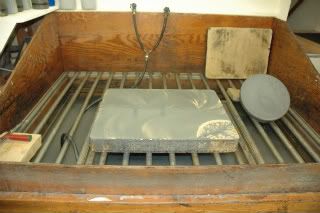
Here is a stone during graining. A small stone like this can take several hours to grain if it isn't flat. It must be absolutely flat or the contact press will miss areas of the drawing that are low.
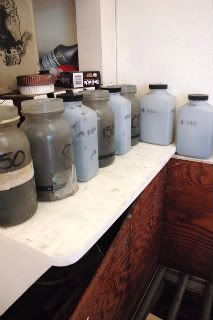
The grains run from 50 to 280, but the stones I have grained run through 60 to 80, 100, 150, 180, 200. It's a long process, but nothing is worse that getting almost finished and picking up a stray coarse grain on the levigator and scratching your rock. This means virtually starting over. At one point, I was assigned to grain several stones at 5:00 pm to be ready for Carroll Dunham at 8:00 the next morning. At the end of a work day this is the last thing you want to hear - but it is a reality of the print studio. So, putting a scratch in one of these at 9:00 pm would make me real sad.
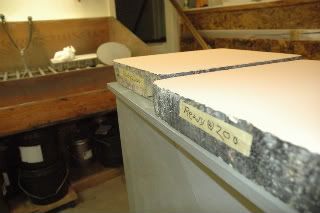
The stones are then marked and set aside for the artist. It generally takes much longer to grain the stone than it does to draw on it.
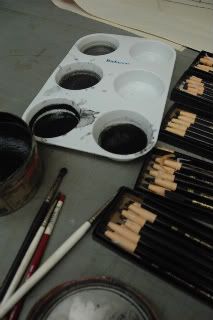
A drawing is done with either Litho crayons (a range of soft and hard, waxy drawing pencils), touche (a water soluble waxy paint, which applies like water color and acts as a resist to water) or a combination of both. You can achieve some really cool things with touche - which reticulates as it dries, making some really nice solid washes, which can be manipulated with crayons as well. The thicker you apply these elements the thicker the resist will be and the darker your image will appear.
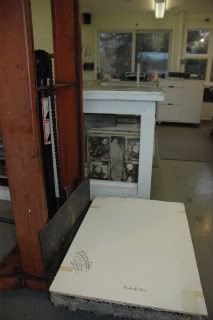
Moving these stones is a real pain - and sometimes they are just too heavy.
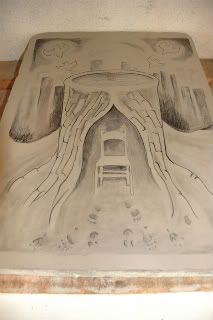
Here is my image. Before etching, talc and resin are dusted onto the stone to cause the ink to thicken. Some of the drawing is wiped away during etching - an important but difficult lesson. Regardless - the resist is so strong once applied that the subtleties re-emerge when inking. Drawing on these is fun - but you cannot erase. So be sure of your image and go gently. Here, gum has been applied to cool the etch, and preserve the stone while it is not in use.
My print will likely be a one block, black and white image - though I could add drawings to include color stones or plates to be done on the offset press. the Carroll Dunham prints pictured below include several stones for each print. registering them gets tricky, especially because the stones are all different sizes, and some have multiple small drawings on them. Each is a different color and represents a different portion of the image. All these elements are matched up with the key drawing - or in this case the black part of the drawing that has the most information in it, which is printed onto a mylar. The mylar helps indicate where the paper must lay each time the image is printed so that all the images match up, and every sheet looks exactly the same as the original proof.
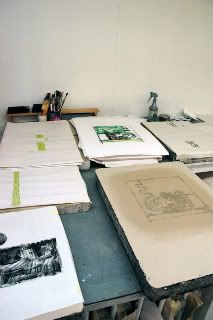
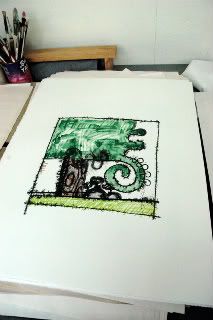
Each stone has a proof of the image covering it to protect the drawing and identify which part of the image is on which rock. All of these separate elements add up to make the final product, pictured right.
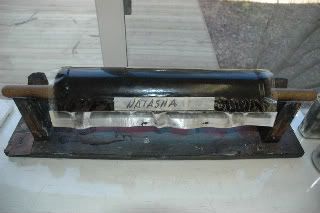
A leather roller is used on many stones to ensure that the image retains the maximum amount of ink without drying the surface of the stone. During inking, the stone must be wet enough to repel the oil based ink from every part of the stone that doesn't have pencil or touche on it.
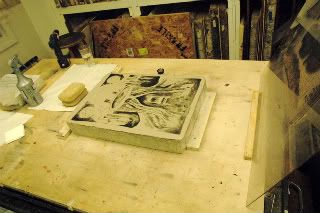
Here is the stone on the press, and after being inked to capacity. Asphaltum and tannic acid are used to cause the greasy drawing ares to retain ink effectively. The press bed beneath the stone must be totally clean - even a hair beneath the pressure of the contact press can cause a stone to crack. Inking lightly first, and then to heavy, the image comes up rather slowly.
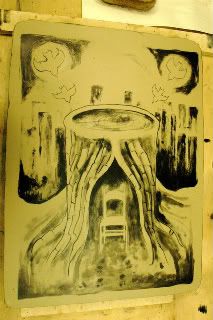
This stone is ready to run through the press, and have proofs pulled from it. It will darken as the the first several proofs are run, and then the amount of ink and pressure can be adjusted to best suit the image quality. Spot etching can be done to increase the amount of detail in reticulation or heavy wash areas. In this case only the very darkest parts of the image need to be re-etched. To add to the drawing, you can counter etch the stone and add more drawing - but aside from small sanding areas, drawn areas cannot be removed.
You can see the progression as the ink builds up on the stone. At this point - unless I decide to further alter the image, this stone is ready to run prints from.
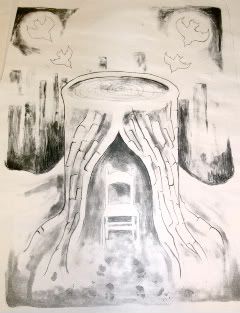
If I ever get the opportunity, I would like to run a small edition of this print, as I am pretty happy with it considering it is my first attempt. Some areas are light - but overall it looks a lot like my drawing after being run on paper. It will darken further, and look much better on white paper. will include an image of this work when I have a decent proof of it - but here is a poor consolation prize:
As I said - you must be persistent to get your own work done. Make it known from day one that you want to make prints and get started on them right away. I started week three, and this is as much as I've gotten done. You will need the help of printers to work in the studio - so buddy up. Otherwise, you will run errands and wash dishes the whole time - and it might not feel worth it.
I'm sure many have wondered why I haven't included any of my NYC adventures here, so that will be my next blog. Suffice it to say: I have done a lot, but could never do it all in four months. Plan things ahead of time! Make use of your weekends! Time Out NY is a great way to keep up with cool stuff going on in the city. Galleries and Museums are free - so that has been a bulk of my experience. More about that later.
revolves around the principle that water and oil repel each other. The process i describe here involves printing directly from a limestone block. Lithography is derived from the Greek word "Lithos" - stone (or from stone), and is a very old and effective method of printing from a smooth surface to paper. However - in order to print effectively - the stone must be completely flat and totally smooth. Thus, before anything else, the stone must be grained, a process by which any previous image or "ghost" is removed from the face of the rock. This is done using a levigator - a heavy round tool which is spun across the surface of the stone after grain has been applied. The process is akin to sanding wood in that you start with a coarse grit and work your way to a fine dust - eventually polishing the surface. No scratches or rough spots can remain, as they will retain ink during printing.

Here is a stone during graining. A small stone like this can take several hours to grain if it isn't flat. It must be absolutely flat or the contact press will miss areas of the drawing that are low.

The grains run from 50 to 280, but the stones I have grained run through 60 to 80, 100, 150, 180, 200. It's a long process, but nothing is worse that getting almost finished and picking up a stray coarse grain on the levigator and scratching your rock. This means virtually starting over. At one point, I was assigned to grain several stones at 5:00 pm to be ready for Carroll Dunham at 8:00 the next morning. At the end of a work day this is the last thing you want to hear - but it is a reality of the print studio. So, putting a scratch in one of these at 9:00 pm would make me real sad.

The stones are then marked and set aside for the artist. It generally takes much longer to grain the stone than it does to draw on it.


A drawing is done with either Litho crayons (a range of soft and hard, waxy drawing pencils), touche (a water soluble waxy paint, which applies like water color and acts as a resist to water) or a combination of both. You can achieve some really cool things with touche - which reticulates as it dries, making some really nice solid washes, which can be manipulated with crayons as well. The thicker you apply these elements the thicker the resist will be and the darker your image will appear.

Moving these stones is a real pain - and sometimes they are just too heavy.

Here is my image. Before etching, talc and resin are dusted onto the stone to cause the ink to thicken. Some of the drawing is wiped away during etching - an important but difficult lesson. Regardless - the resist is so strong once applied that the subtleties re-emerge when inking. Drawing on these is fun - but you cannot erase. So be sure of your image and go gently. Here, gum has been applied to cool the etch, and preserve the stone while it is not in use.
My print will likely be a one block, black and white image - though I could add drawings to include color stones or plates to be done on the offset press. the Carroll Dunham prints pictured below include several stones for each print. registering them gets tricky, especially because the stones are all different sizes, and some have multiple small drawings on them. Each is a different color and represents a different portion of the image. All these elements are matched up with the key drawing - or in this case the black part of the drawing that has the most information in it, which is printed onto a mylar. The mylar helps indicate where the paper must lay each time the image is printed so that all the images match up, and every sheet looks exactly the same as the original proof.


Each stone has a proof of the image covering it to protect the drawing and identify which part of the image is on which rock. All of these separate elements add up to make the final product, pictured right.

A leather roller is used on many stones to ensure that the image retains the maximum amount of ink without drying the surface of the stone. During inking, the stone must be wet enough to repel the oil based ink from every part of the stone that doesn't have pencil or touche on it.

Here is the stone on the press, and after being inked to capacity. Asphaltum and tannic acid are used to cause the greasy drawing ares to retain ink effectively. The press bed beneath the stone must be totally clean - even a hair beneath the pressure of the contact press can cause a stone to crack. Inking lightly first, and then to heavy, the image comes up rather slowly.

This stone is ready to run through the press, and have proofs pulled from it. It will darken as the the first several proofs are run, and then the amount of ink and pressure can be adjusted to best suit the image quality. Spot etching can be done to increase the amount of detail in reticulation or heavy wash areas. In this case only the very darkest parts of the image need to be re-etched. To add to the drawing, you can counter etch the stone and add more drawing - but aside from small sanding areas, drawn areas cannot be removed.

You can see the progression as the ink builds up on the stone. At this point - unless I decide to further alter the image, this stone is ready to run prints from.
If I ever get the opportunity, I would like to run a small edition of this print, as I am pretty happy with it considering it is my first attempt. Some areas are light - but overall it looks a lot like my drawing after being run on paper. It will darken further, and look much better on white paper. will include an image of this work when I have a decent proof of it - but here is a poor consolation prize:

As I said - you must be persistent to get your own work done. Make it known from day one that you want to make prints and get started on them right away. I started week three, and this is as much as I've gotten done. You will need the help of printers to work in the studio - so buddy up. Otherwise, you will run errands and wash dishes the whole time - and it might not feel worth it.
I'm sure many have wondered why I haven't included any of my NYC adventures here, so that will be my next blog. Suffice it to say: I have done a lot, but could never do it all in four months. Plan things ahead of time! Make use of your weekends! Time Out NY is a great way to keep up with cool stuff going on in the city. Galleries and Museums are free - so that has been a bulk of my experience. More about that later.
Monday, February 18, 2008
An Intern Reflects!
Being an intern can be hard on the soul - but but keeping a certain perspective on things makes all the difference.
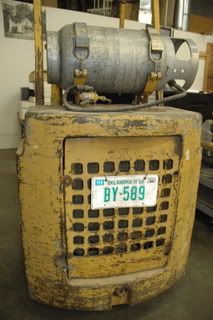
The forklift at the studio has Mr. Goldston's 1984 Oklahoma tags on it. You might not be the butt of any Oklahoma jokes - but I would be shocked if you weren't. I have to admit, Oklahomans must seem pretty peculiar to this crowd.
Not much visual aid this week, or rather, what there is has little to do with the text. Suffice it to say I've been much busier and involved in the goings on at ULAE, so photography takes a backseat, and you get tasty leftovers that I couldn't fit in previous blogs.
It might be advantageous to discuss a few things I've noticed about this place, and the art world at large. I will try to keep this as positive as possible. Becoming more involved has led me to realize what a blessing an art related job such as this can be. If there is any single thing I have learned from this experience it is that there is life beyond art school. One simply must know where to look, and be willing to pay one dues. Certainly, this won't put anyone on a faster track to making it big as a visual artist, but it depends on how you use the facilities at your disposal, and put what you learn as a printer to use. The level of professionalism exercised at this shop has forced me to work on my own precision and attention to detail. It has effected the quality of my own work immensely, and my attitude towards art making in general. Then of course there is the development of new skills and familiarization with new aspects of the trade - but this will take years. Many printers here have a specialization, but broaden into other areas out of necessity in producing large editions of a certain type. Just in standing by and being a nuisance I have gotten a crash course in litho, aquatint, intaglio, and photogravieur. As I understand it, every studio has it's own methods in each area, so it isn't surprising that they do things differently here than at Gemini, or Tandem (or OK State).
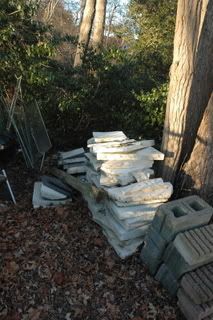
A pile of broken lithographic stones sit behind Skidmore Place.
The downside of course is that the pressure is immense at times, and putting any of this knowledge to use in personal projects might be hard to do. Deadlines on large editions change at a moments notice, artists drop in to check on their work, or to create new work, and the level of craftsmanship cannot falter due to shortage of time. There is a lot of money involved here, so keeping it cool and staying focused is important. Things must be done right - and there is an enormous number of variables that ensure that things will go wrong. I have already noticed a decrease in my enthusiasm, though I chock most of it up to being the intern, and wading in the muck at the bottom of the heap. Some days I feel like a printer, and am treated as such - and other days I am DEFINITELY the intern. I am constantly reminded of my place. The other thing that I picked up on rather quickly is that many of the people who work here commute and hour or an hour and a half and the beginning and the end of each day. I thought at first it was just stubbornness - insisting to live in Brooklyn because of the cool factor. But I can honestly say that I never want to live on Long Island again in my life. There is no one above high school age or below mid forties that lives here as far as I can tell, and thus there is very little to do. I find myself, as well, living for the next chance to get into Manhattan or Williamsburg or Park Slope. So - if the printers seem grumpy, just imagine yourself in their position. It's a great job, but it is also a lot of baggage and stress.
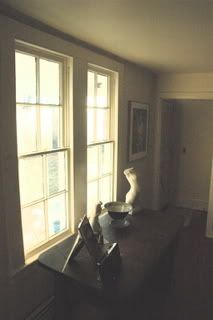
A shot from the front room of Skidmore. On a nice days, Skidmore can be a lovely place to be.
It can be tremendously rewarding some days, and other days it can make you feel like dirt. I guess this aspect of being a working stiff has always eluded me - and I can honestly say I miss college a lot already. However - it has been a huge eye opener as to how the art world works, and as to what goes on behind the scenes. One printer said that he went to to Met to see the new Jasper Johns "Gray" exhibit, which featured many prints that he himself had pulled and handled. However his name is nowhere on that sheet of paper. Only Johns'. Not surprisingly, most of the notable artists who work with ULAE haven't set foot in Bayshore in years, but still have their prints editioned here. Is it right or wrong? I don't know - it just is. I know that part of the thrill of making prints for me is actually making the prints. I like to be involved in every step of the process - but I am not a famous artist, and if I were I can hardly say that I wouldn't let ULAE edition my prints for me and sell them for big money. I can't say it doesn't sound appealing. It is still awe inspiring to be in the presence of such history and legacy - but if I hadn't come out here to do this I may never have realized that such a place existed. I always thought the art and the artist were inseparable - as naive as it sounds - but it makes complete sense that the thing that can drive the two apart should be the almighty dollar. I might sound jaded - but I'm totally comfortable with it - not that it's up to me. It's just been a real eye opener. Strangely though - this awesome opportunity has really helped me reconcile with my decision to go into the arts. It is always breathing down my neck - what comes after school? Do I really expect to make a living on paintings? In a culture driven by media, fast news, flashing lights and dwindling attention spans, do I really expect to get anyone's attention? The average time a gallery goer takes to look at a painting is less than 3 seconds. The art world is subsequently very tough and fickle, and riddled with nepotism and politics - and all of these things should inform the student of the arts about the path before him. While there is a strange, naive comfort in being the penniless underdog, sticking to his genuine artistic ideals and creating meaningful but misunderstood work only to be praised after his death - seeing what these printers do gives me a great deal of hope and optimism. I can see myself in a job like this one day, becoming a master of a respectable trade, and living off of it in order to feed myself while kicking the dream around. There is one printer here who I relate to on this level - and he uses all of his time outside of the studio to create his own work. He makes use of the facilities at Clinton, and produces really nice work. I see this as an admirable use of his occupational situation - though the trade offs are great (he resides in Bayshore) he is still on track to a career as a professional artist. Being close to NYC with a stable income is a tremendous asset to this goal, because if there's one thing NYC has, it's money, where there's money there is much more likely to be an art market. Culture is one thing that New York is not shy of - and for a county boy like me, that's real derned excitin'.
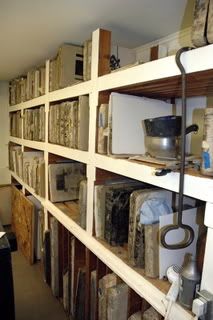
Studio at Skidmore is like a litho library documenting the presence of people like Motherwell, Frankenthaler, Dine and Oldenberg. The litho images of their work are, by and large, untouched.
For a great bit of history and an awesome photo essay about ULAE - make sure to check
out their new website: http://www.ulae.com

The forklift at the studio has Mr. Goldston's 1984 Oklahoma tags on it. You might not be the butt of any Oklahoma jokes - but I would be shocked if you weren't. I have to admit, Oklahomans must seem pretty peculiar to this crowd.
Not much visual aid this week, or rather, what there is has little to do with the text. Suffice it to say I've been much busier and involved in the goings on at ULAE, so photography takes a backseat, and you get tasty leftovers that I couldn't fit in previous blogs.
It might be advantageous to discuss a few things I've noticed about this place, and the art world at large. I will try to keep this as positive as possible. Becoming more involved has led me to realize what a blessing an art related job such as this can be. If there is any single thing I have learned from this experience it is that there is life beyond art school. One simply must know where to look, and be willing to pay one dues. Certainly, this won't put anyone on a faster track to making it big as a visual artist, but it depends on how you use the facilities at your disposal, and put what you learn as a printer to use. The level of professionalism exercised at this shop has forced me to work on my own precision and attention to detail. It has effected the quality of my own work immensely, and my attitude towards art making in general. Then of course there is the development of new skills and familiarization with new aspects of the trade - but this will take years. Many printers here have a specialization, but broaden into other areas out of necessity in producing large editions of a certain type. Just in standing by and being a nuisance I have gotten a crash course in litho, aquatint, intaglio, and photogravieur. As I understand it, every studio has it's own methods in each area, so it isn't surprising that they do things differently here than at Gemini, or Tandem (or OK State).

A pile of broken lithographic stones sit behind Skidmore Place.
The downside of course is that the pressure is immense at times, and putting any of this knowledge to use in personal projects might be hard to do. Deadlines on large editions change at a moments notice, artists drop in to check on their work, or to create new work, and the level of craftsmanship cannot falter due to shortage of time. There is a lot of money involved here, so keeping it cool and staying focused is important. Things must be done right - and there is an enormous number of variables that ensure that things will go wrong. I have already noticed a decrease in my enthusiasm, though I chock most of it up to being the intern, and wading in the muck at the bottom of the heap. Some days I feel like a printer, and am treated as such - and other days I am DEFINITELY the intern. I am constantly reminded of my place. The other thing that I picked up on rather quickly is that many of the people who work here commute and hour or an hour and a half and the beginning and the end of each day. I thought at first it was just stubbornness - insisting to live in Brooklyn because of the cool factor. But I can honestly say that I never want to live on Long Island again in my life. There is no one above high school age or below mid forties that lives here as far as I can tell, and thus there is very little to do. I find myself, as well, living for the next chance to get into Manhattan or Williamsburg or Park Slope. So - if the printers seem grumpy, just imagine yourself in their position. It's a great job, but it is also a lot of baggage and stress.

A shot from the front room of Skidmore. On a nice days, Skidmore can be a lovely place to be.
It can be tremendously rewarding some days, and other days it can make you feel like dirt. I guess this aspect of being a working stiff has always eluded me - and I can honestly say I miss college a lot already. However - it has been a huge eye opener as to how the art world works, and as to what goes on behind the scenes. One printer said that he went to to Met to see the new Jasper Johns "Gray" exhibit, which featured many prints that he himself had pulled and handled. However his name is nowhere on that sheet of paper. Only Johns'. Not surprisingly, most of the notable artists who work with ULAE haven't set foot in Bayshore in years, but still have their prints editioned here. Is it right or wrong? I don't know - it just is. I know that part of the thrill of making prints for me is actually making the prints. I like to be involved in every step of the process - but I am not a famous artist, and if I were I can hardly say that I wouldn't let ULAE edition my prints for me and sell them for big money. I can't say it doesn't sound appealing. It is still awe inspiring to be in the presence of such history and legacy - but if I hadn't come out here to do this I may never have realized that such a place existed. I always thought the art and the artist were inseparable - as naive as it sounds - but it makes complete sense that the thing that can drive the two apart should be the almighty dollar. I might sound jaded - but I'm totally comfortable with it - not that it's up to me. It's just been a real eye opener. Strangely though - this awesome opportunity has really helped me reconcile with my decision to go into the arts. It is always breathing down my neck - what comes after school? Do I really expect to make a living on paintings? In a culture driven by media, fast news, flashing lights and dwindling attention spans, do I really expect to get anyone's attention? The average time a gallery goer takes to look at a painting is less than 3 seconds. The art world is subsequently very tough and fickle, and riddled with nepotism and politics - and all of these things should inform the student of the arts about the path before him. While there is a strange, naive comfort in being the penniless underdog, sticking to his genuine artistic ideals and creating meaningful but misunderstood work only to be praised after his death - seeing what these printers do gives me a great deal of hope and optimism. I can see myself in a job like this one day, becoming a master of a respectable trade, and living off of it in order to feed myself while kicking the dream around. There is one printer here who I relate to on this level - and he uses all of his time outside of the studio to create his own work. He makes use of the facilities at Clinton, and produces really nice work. I see this as an admirable use of his occupational situation - though the trade offs are great (he resides in Bayshore) he is still on track to a career as a professional artist. Being close to NYC with a stable income is a tremendous asset to this goal, because if there's one thing NYC has, it's money, where there's money there is much more likely to be an art market. Culture is one thing that New York is not shy of - and for a county boy like me, that's real derned excitin'.

Studio at Skidmore is like a litho library documenting the presence of people like Motherwell, Frankenthaler, Dine and Oldenberg. The litho images of their work are, by and large, untouched.
For a great bit of history and an awesome photo essay about ULAE - make sure to check
out their new website: http://www.ulae.com
Thursday, January 31, 2008
I Helped.......?
SOME THINGS I DID IN THE FIRST MONTH:
As an intern, I have been unsure about my position - though I am certain it is at the bottom. Still, it is pretty hard to know where to you stand. Some days the intern will feel as though he can do absolutely nothing right - but it gets better. Just remember that you are here to learn - and try not to be shy. It is good to know how to keep your eyes and ears open and your mouth shut - but nothing will be handed to you at ULAE in terms of learning. I mostly have just hovered over the printers and picked their brains - asked questions about everything they are doing, to which some printers respond much better than others. Don't feel like a nuisance - you are one - but don't let it get to you. Besides the alternative is running errands and doing office work. Since I've been here, I have helped the printers with a number of things, including helping with a Rosa Loy Litho edition. This has included some menial press operation tasks, wiping plates and cleaning rollers. I feel good about this work because it saves the printer a whole lot of time and elbow grease. On the Loy edition we ran abut 80 sheets, which means a lot of work on ach individual sheet at mant different stages. I started out by tearing paper, then cleaning plates, and wiping the litho block on the stone press. I was then assigned to tear paper AGAIN, which is the last step before curating. I will go into a bit more detail about litho and etching in later blogs - but suffice it to say, just by making myself available I have learned a whole lot through proximity and practice.
Sorry these are not chronological by any means -- damn technology!
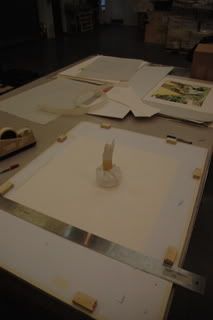
To tear down paper for the finished prints, a tear down block is constructed to ensure that every sheet of the edition is exactly the same. The borders round the image must be the same for every sheet. The paper is held in place with pins in the registration marks, and then weighted so the paper doesn't move. It seems like a male job - but these are very expensive sheets of paper, so it must be done right.
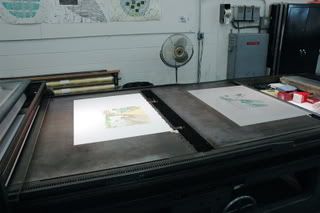
The offset press is an essential element of the editioning process. It allows an unlimited number of prints to be run in a very short amount of time. That doesn't make it easy - it is a high maintenance machine and there are many variables that can cause printing to be a nightmare if overlooked. The Rosa Loy prints were three base colors - so 80 sheets of paper run 3 times with a different plate - thats 240 runs, then black, run on the old litho press - which in itself took an entire workday, and we only got up to the 60th sheet. In between each run, registration must be checked - ink added or removed, blankets wetted, and routine trouble shooting. The printer must also make sure every print looks exactly the same in terms of color. You can see where an apprentice is a huge help.
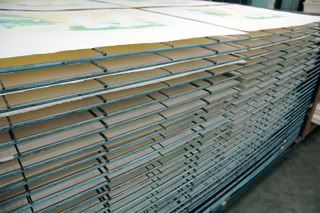
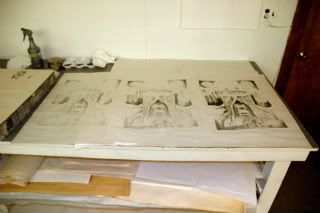
Here is the whole edition prior to printing the black. Some editions are several hundred - and when you get into the Johns and Rauschenbergs, even more. Each sheet is worth a TON of money. Printers get printer's proofs, which are only saleable after the edition sells out.
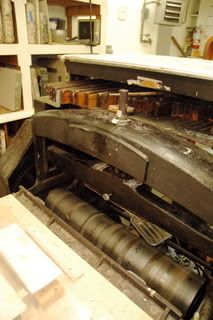
Here is a shot of the press at Skidmore. The surface of the sone must remain wet at all times during the printing process - so having someone to wet the stone is a neccesity. The registration setup took a little trouble shooting - but the printer eventually devised a very simple and efective system, and with two people, the last step of the editioning process went very smoothly - though it took about 8 hours of standing over the press.
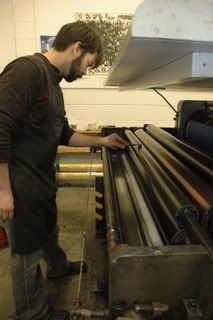
Jason (the man who taught me everything In know about Lithography) carefully adds ink into the rollers, which will even distribute and oscillate the ink so it prints completely flat. The printer must often rely on sight and intuition to add and remove ink or pressure so that all prints match the matchup proof, which has been aproved by the artist prior to editioning.
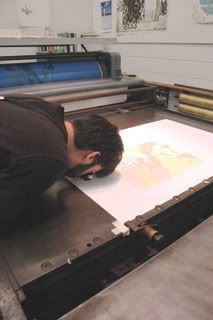
This is a very breif overveiw of my apprentice work with litho. Next week - what I've learned about etching.
As an intern, I have been unsure about my position - though I am certain it is at the bottom. Still, it is pretty hard to know where to you stand. Some days the intern will feel as though he can do absolutely nothing right - but it gets better. Just remember that you are here to learn - and try not to be shy. It is good to know how to keep your eyes and ears open and your mouth shut - but nothing will be handed to you at ULAE in terms of learning. I mostly have just hovered over the printers and picked their brains - asked questions about everything they are doing, to which some printers respond much better than others. Don't feel like a nuisance - you are one - but don't let it get to you. Besides the alternative is running errands and doing office work. Since I've been here, I have helped the printers with a number of things, including helping with a Rosa Loy Litho edition. This has included some menial press operation tasks, wiping plates and cleaning rollers. I feel good about this work because it saves the printer a whole lot of time and elbow grease. On the Loy edition we ran abut 80 sheets, which means a lot of work on ach individual sheet at mant different stages. I started out by tearing paper, then cleaning plates, and wiping the litho block on the stone press. I was then assigned to tear paper AGAIN, which is the last step before curating. I will go into a bit more detail about litho and etching in later blogs - but suffice it to say, just by making myself available I have learned a whole lot through proximity and practice.
Sorry these are not chronological by any means -- damn technology!
To tear down paper for the finished prints, a tear down block is constructed to ensure that every sheet of the edition is exactly the same. The borders round the image must be the same for every sheet. The paper is held in place with pins in the registration marks, and then weighted so the paper doesn't move. It seems like a male job - but these are very expensive sheets of paper, so it must be done right.
The offset press is an essential element of the editioning process. It allows an unlimited number of prints to be run in a very short amount of time. That doesn't make it easy - it is a high maintenance machine and there are many variables that can cause printing to be a nightmare if overlooked. The Rosa Loy prints were three base colors - so 80 sheets of paper run 3 times with a different plate - thats 240 runs, then black, run on the old litho press - which in itself took an entire workday, and we only got up to the 60th sheet. In between each run, registration must be checked - ink added or removed, blankets wetted, and routine trouble shooting. The printer must also make sure every print looks exactly the same in terms of color. You can see where an apprentice is a huge help.
Here is the whole edition prior to printing the black. Some editions are several hundred - and when you get into the Johns and Rauschenbergs, even more. Each sheet is worth a TON of money. Printers get printer's proofs, which are only saleable after the edition sells out.
Here is a shot of the press at Skidmore. The surface of the sone must remain wet at all times during the printing process - so having someone to wet the stone is a neccesity. The registration setup took a little trouble shooting - but the printer eventually devised a very simple and efective system, and with two people, the last step of the editioning process went very smoothly - though it took about 8 hours of standing over the press.
Jason (the man who taught me everything In know about Lithography) carefully adds ink into the rollers, which will even distribute and oscillate the ink so it prints completely flat. The printer must often rely on sight and intuition to add and remove ink or pressure so that all prints match the matchup proof, which has been aproved by the artist prior to editioning.
This is a very breif overveiw of my apprentice work with litho. Next week - what I've learned about etching.
Monday, January 28, 2008
The ULAE Studio at Clinton Ave., Bayshore
The facilities here are unbelievable - and there is a lot to take in. I may not have time to learn what everything does, but I have already gotten some time in helping printers, and there is simply no better way to learn than hanging with these guys. This is a very, very brief tour of Clinton, I couldn't possibly cover it all - but you will see a lot more of the studio in the coming week as I outline my experiences as an apprentice. (Note the use of the word apprentice: it has much nicer sound to it. There are intern jobs, and there are apprentice jobs. If you have any interest in learning about these presses, you'll have to get in there and get your hands dirty.)
A master printer work on an offset press in the studio "across the street." The offset press is used to produce large quantities of lithographic prints. There are three of such presses at ULAE.
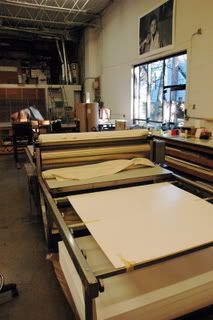
This is a motorized press used for printing very large intaglio prints, or etchings.
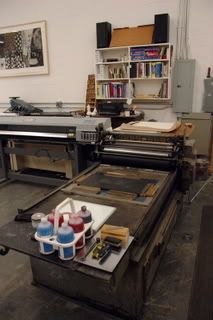
Here is an old school letter press, which as far as I can tell is used primarily for portfolio type, but I have also seen it used to generate text on litho plates.
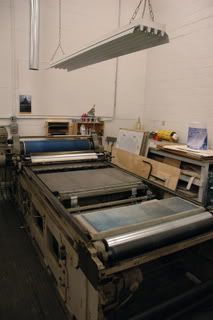
This press hasn't been used since I've been here - but it is one of the three offset presses here.
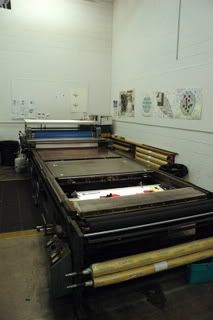
This is the press I've become most familiar with. One of the printers has let me help him with a few proofs and even an edition. I will go into the details of my first hand experience a little later.
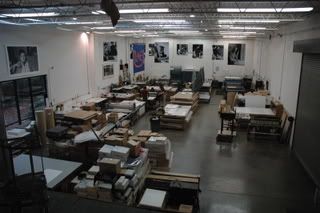
The ceilings of the main studio have large portraits of artists working here and at the studio in Skidmore Place. It's fun to pick out where the are in each photo and try to picture Barnett Newman or Lee Bontecou standing in that exact location when you get home.
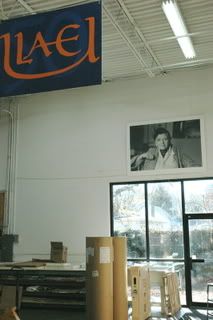
A portrait of Tatyana overlooks it all - if you mess up, she'll know.
A master printer work on an offset press in the studio "across the street." The offset press is used to produce large quantities of lithographic prints. There are three of such presses at ULAE.
This is a motorized press used for printing very large intaglio prints, or etchings.
Here is an old school letter press, which as far as I can tell is used primarily for portfolio type, but I have also seen it used to generate text on litho plates.
This press hasn't been used since I've been here - but it is one of the three offset presses here.
This is the press I've become most familiar with. One of the printers has let me help him with a few proofs and even an edition. I will go into the details of my first hand experience a little later.
The ceilings of the main studio have large portraits of artists working here and at the studio in Skidmore Place. It's fun to pick out where the are in each photo and try to picture Barnett Newman or Lee Bontecou standing in that exact location when you get home.
A portrait of Tatyana overlooks it all - if you mess up, she'll know.
Friday, November 9, 2007
Getting down to buisness!!!
So as a intern here you will be expected to do work....Duh! So what types of work will this entail you might ask? (Sometimes I still ask myself the same question) Well my answer is it all really depends, it can change day to day or week to week. What you really need to know is that it varies greatly and can at times be frustrating. You could for instance be working on a print for several weeks and when thats done you might be raking tons and tons of leaves. Alot of what you end up doing is based on what needs to be done around the studio and what other people don't have enough time to do. You run alot of errands, pick up lunch, pick up people from the train station, and various other such things. Sometimes you will be required to go to the city and help out with a gallery opening. Since I was here during the 50 year celebration I did alot of work to help prepare for that. You do dishes, read through magazines to find ULAE artist, sweep, take out trash.....etc. One might ask why would I want to do this stuff, and my answer is that though the work sometimes might be boring or menial there is a huge possibility to what you can learn or do while in NY, and its basically FREE. Because when it really comes down to it, its what you choose to do with your time and what you choose to learn that matters most. NYC is a beacon for possibility.....To expand your mind, expand your future and expand your wallet.
Wednesday, November 7, 2007
Your Second home.....
The actual studio space for ULAE is located at 1446 s. Clinton ave in Bay Shore, NY. Which it is important to note it is three towns over from Skidmore place where you live. Now not being here it is hard to understand just how the towns here are laid out, it is really a lot different than in Oklahoma, for being three towns away from where you live it is still not the distance if you drove from one end of Stillwater to the other. They a mostly very small towns in which you can not easily tell where one ends and another begins (Aside from signs.) Though it does make having a car a real necessity. I personally came thinking I would be just fine riding my bike here, since thats all I did in Oklahoma. Not so, everything as far as groceries and eateries is no where near where you live and the ride to work takes 30 min on a bike, making it an hour commute day. Plus the fact that you are inevitably going to be running errands almost everyday. Its just the way it is, for being so close to NYC this is a very, very residential area.
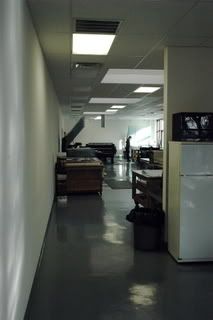
Below are several pictures of the studio space at Clinton Ave. Just so you get a idea of where you will be working. Hours are from 8:30 - 5:30 mon-fri. You have the weekends off to roam the city.

Below are several pictures of the studio space at Clinton Ave. Just so you get a idea of where you will be working. Hours are from 8:30 - 5:30 mon-fri. You have the weekends off to roam the city.


Tuesday, November 6, 2007
My First Project at ULAE

completely approved
and from which all other print will be measured
for accuracy) Each of these prints had 80 copies printed and painted, and the final number used for the edition came out to be 24 and 26. I was engaged with each step of the process on these prints and found it to be very fulfilling to be able to be apart of the finished prints. I am attaching some photo's that were taken during this process.


Subscribe to:
Posts (Atom)